Basement stair repair: fixing creaky, loose or unsafe cellar steps
What causes creaky, sagging and rotted cellar stairs, which problems are simple fixes, and when a basement stair should be rebuilt to current standards.
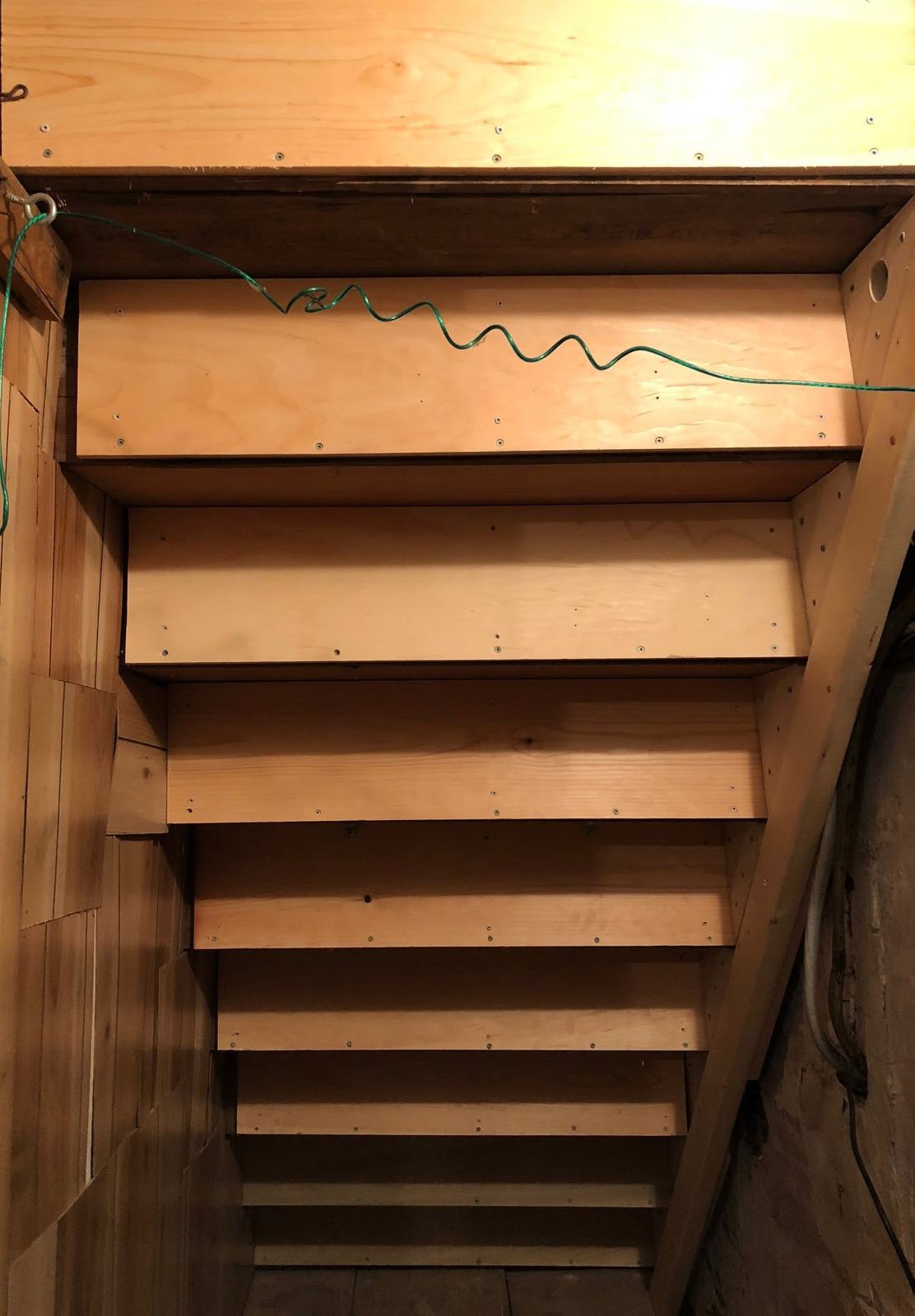
Most basement stair repairs come down to three problems. Treads come loose or crack, stringers rot where they meet a damp floor, and handrails are missing or wobbly. Loose treads can usually be re-fastened, and a single cracked tread can be replaced. When the stringers are soft, the steps are uneven, or the stair was built steep and narrow to begin with, rebuilding it is often safer and not much more involved than a string of repairs. In the older houses of Ballston Spa and the surrounding villages, cellar stairs were often built as utility stairs and have had a century of damp air to work on them.
Why cellar stairs fail
Basement stairs live in harder conditions than the stairs upstairs. Many older Capital Region basements have stone or rubble foundations and dirt or thin concrete floors, so the air is damp for much of the year. The bottom of the stair stringers often rests directly on that floor, where it wicks up moisture. Over decades the end grain softens and the stair begins to settle and sag.
Other common causes include:
- Treads nailed rather than screwed or glued, which loosen as the wood shrinks and swells
- Stringers cut from undersized lumber or notched too deeply
- Water entering from a bulkhead or a foundation crack and running down the steps
- Previous repairs that added layers of plywood or carpet without fixing the structure
- Heavy loads such as appliances or boxes carried up and down for years
How to inspect a basement stair
Take a flashlight and look at the stair from the front and from underneath.
From above
- Walk up and down slowly and note any tread that creaks, rocks or flexes.
- Look for cracks across treads, especially near the front edge.
- Check whether the steps feel uneven. A step that is noticeably taller or shorter than the others is a tripping hazard.
- Grab the handrail and pull on it. It should not move.
From below
- Probe the bottom of each stringer with a screwdriver where it meets the floor. Soft or crumbling wood is the main warning sign.
- Look for dark staining, mold or white fuzzy growth on the wood, which points to persistent moisture.
- Check how the top of the stair is fastened to the floor framing. Old stairs were sometimes simply nailed to the edge of a joist and have pulled loose.
- Look at whether the treads are supported by the stringers along their full width or just resting on small cleats.
Mold on stair framing deserves attention. Small areas of surface growth on wood can often be cleaned once the moisture source is fixed, but extensive mold, or mold on other materials in the basement, is a job for a professional who handles mold remediation.
Simple fixes vs a rebuild
| What you found | Usual approach |
|---|---|
| A creak or slight movement in one or two treads | Re-fasten treads to the stringers with screws and construction adhesive |
| One cracked or split tread | Replace that tread |
| Loose handrail | Re-anchor brackets into solid framing, or add a new rail |
| Soft wood at the bottom few inches of the stringers | Sister new stringer sections, or rebuild the lower stair |
| Rot spread through the stringers, uneven rises, steep pitch | Rebuild the stair |
Sistering means fastening new lumber alongside the damaged section to carry the load. It works when the rot is limited and the rest of the stringer is solid. If the stringers are soft along much of their length, or the stair was poorly laid out in the first place, a rebuild gives a better result.
When we rebuild a cellar stair, we lift the bottom of the stringers off the damp floor, usually by setting them on a small concrete pad or a moisture barrier, and use treated or rot-resistant lumber where contact with masonry or the floor is unavoidable.
What the code says about stairs
The New York State Residential Code, based on the International Residential Code, sets requirements for new stairs. A handrail is required on any stair with four or more risers, mounted 34 to 38 inches above the nosings of the treads. For new construction the code also limits how tall each step can be and how shallow each tread can be, and it calls for steps of consistent height so people do not trip. Under the IRC, risers can be no more than 7 3/4 inches and treads at least 10 inches deep, and your local building department can confirm what applies to your project.
Many older cellar stairs are steeper than this, with tall risers and shallow treads. Repairs to an existing stair often do not trigger full compliance, but a full rebuild usually does. In a tight basement, fitting a compliant stair may mean changing where the stair lands or how it turns. Check with your town or village building department before rebuilding, and see our post on when stairs need a handrail for more on rail placement.
Make the stair safer while you plan
Even before a repair, a few changes reduce the chance of a fall:
- Add a handrail on at least one side if there is none.
- Improve the lighting with a switch at both the top and bottom of the stair. Have an electrician do the wiring.
- Mark the top and bottom steps with contrasting paint or tape so they are easy to see.
- Remove stored items from the steps and the landing.
- Add slip-resistant treads if the steps are painted or worn smooth.
These steps matter most for anyone who has balance or vision changes. Our home safety checklist for elderly parents covers other parts of the house as well.
Deal with the moisture
A rebuilt stair will rot again if it sits in water. Before or during the repair, find out where the moisture comes from. Common sources include an outside bulkhead that leaks, downspouts discharging next to the foundation, ground that slopes toward the house, and high humidity in summer. A leaking cellar door is covered in our post on bulkhead door replacement signs. Running a dehumidifier during humid months helps protect the stair, the floor framing and anything stored in the basement.
If you live in an older home in the village, our guide to remodeling older homes in Ballston Spa covers other problems that tend to show up in houses of that age.
Frequently asked questions
Why do my basement stairs creak?
Creaks usually come from treads that have loosened on the stringers as the wood dried and shrank. Each step lets the tread rub against a nail or the stringer. Re-fastening the treads with screws and adhesive often quiets them, but check the stringers for rot at the same time.
Can I repair just the bottom of rotted basement stair stringers?
If the rot is limited to the bottom few inches and the rest of the stringer is solid, new lumber can be sistered alongside to carry the load. If rot extends further up or the stair is uneven, rebuilding is usually the better choice.
Does a basement stair need a handrail?
Under the New York State Residential Code, any stair with four or more risers needs a handrail. Most basement stairs have more than that, so a sturdy handrail mounted 34 to 38 inches above the tread nosings is worth adding.
We rebuild cellar stairs and replace worn bulkheads as part of our bulkheads and outdoor work, and we work throughout the Capital Region, including Ballston Spa. Every project starts with a site visit and a written scope of work by phase, with the price tied to each phase.